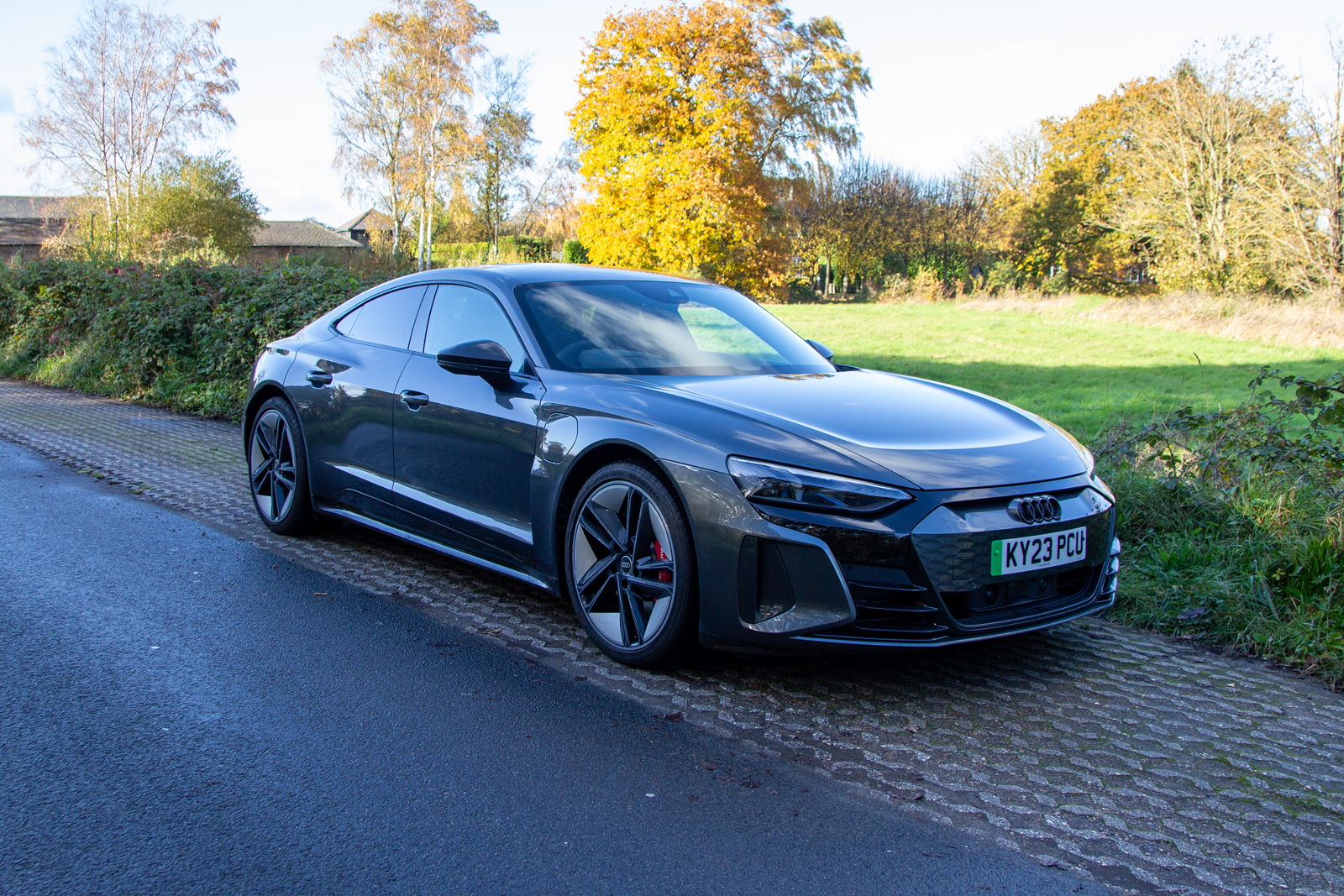
Audi’s first electric car was perhaps predictable: the Audi e-tron, now rebranded as the Q8 e-tron, was designed to be a like-for-like swap for the company’s biggest SUV. Predictable, perhaps, but also a safe bet, seeing as SUVs are what people like to buy. The Audi e-tron GT RS, however, is much more ambitious, a true flagship for Audi’s move towards electrification.
Sitting on the same platform as the Porsche Taycan – widely regarded as the best electric car you can buy – the Audi e-tron GT is something of a risk. While the Taycan logically sits in Porsche’s line-up, for Audi, the GT is more of an outlier. But what an outlier it is: the Audi e-tron GT RS is fantastic.
The Disconnekt Downlow
Pros
+ Outstanding to drive
+ Quality of the interior
+ Practical and comfortable
Cons
– Infotainment a little outdated
– Bonnet experience
– Expensive
The Audi e-tron GT RS is a high-performance electric car with exhilarating driving dynamics, a luxurious interior and a head-turning design. There is 270kW fast charging and surprising space for a sports car, but it comes at a hefty price and some features are optional extras, like adaptive cruise control. The infotainment system is perhaps a little graphically outdated, but this car will not fail to out a smile on your face once you’re on the road. There is the small issue of the Porsche Taycan as a serious rival, but in terms of the performance, it’s hard to choose between the two. The Audi e-tron GT RS is a thrilling drive for those seeking a luxurious and exclusive electric car, but be prepared for the price tag.
See it here on Audi.com for £120,515
Audi e-tron GT RS fun stuff: Design, interior and the tech
‘It looks like the Batmobile’ was perhaps my favourite comment on the design of the Audi e-tron GT RS. The hunkered brute of an electric car sat on my drive for 3 months, replacing my (no longer practical) diesel car. The challenge stretched beyond sampling the finer side of electric driving: I wanted to know how I would cope with those longer drives, those tighter turnarounds where I had to take advantage of fast charging. I wanted to know if it was going to be practical beyond the luxurious.
The Batmobile feel spreads to the inside, where my review model was a cocoon of inky darkness. From the carbonfibre inlays to the Alcantara finish, there’s a seriously high-quality finish to everything. Some of the interior uses glossy black plastic, particularly between the front seats and it is prone to attract fingerprints, but that’s a minor gripe.


IMAGE CREDIT: THE DISCONNEKT
Audi’s seats offer a lot of adjustability (and heating and cooling with the right package) and grip you firmly, reducing passenger roll through those faster corners – and if you buy a car like this, there should be plenty of fast corners. The second row is surprisingly spacious: this car may have a squat profile, but there’s ample head and legroom for adults in the back – a generous boot offering 350 litres (the regular GT is larger with 405 litres), while a frunk under the bonnet provides an additional 85 litres, although you’ll likely use that for cables and little else.
The bonnet is my biggest design criticism, if I’m being really picky. It looks great and the release button on the end of the driver’s door is an interesting quirk, but when you come to close the bonnet, you really do have to slam it down with a clatter. If you keep your cables in the frunk, you’ll be doing that more often than you expect.
“
Audi MMI feels a bit old at this point: it’s sophisticated enough, but in modern terms the display is a little small and graphically it’s a little safe.
Audi’s interior tech is based around Audi MMI. There’s Audi’s Virtual Cockpit for the instrument panel, with a central 10.1-inch display. Everything is designed around the driver, so slightly canted to one side which gives it a bit of a wonky look. It features a haptic system for touch feedback, but thankfully buttons remain for climate control, while a central media controller will let you pause and tweak the volume – ideal for passenger control.
Audi MMI feels a bit old at this point: it’s sophisticated enough, but in modern terms the display is a little small and graphically it’s a little safe. But the advantage this system has is the Virtual Cockpit, as you can have full screen mapping paired with a heads-up display, it’s a great combination. Wireless Apple CarPlay and Android Auto are supported, but then you lose that navigation crossover into the driver’s eyeline, with everything staying on the central display instead.

IMAGE CREDIT: THE DISCONNEKT
Make no mistake, the Audi e-tron GT RS is a great place to be. It’s a car that turns heads, it gets people talking – and it’s rarer than the Porsche Taycan, while being no less proficient. Having driven thousands of miles in the e-tron GT RS, the tranquillity, the sense of sophistication and calm on the interior remain with me.
Of course, when you put your foot down, this car comes to life, leaving you grinning behind the noise-insulating glass.
Audi e-tron GT RS essentials: Range, battery and driving performance
With electric cars driving pretty much in silence many manufacturers are creating artificial soundtracks. The Audi e-tron GT sounds futuristic, an enveloping symphony that can be heard inside and out (in some instances), that gives the car a little more personality. Sure, you can’t replace the exhaust note of Audi’s beautiful 4-litre V8 (found in the RS 6 for example), but Audi’s soundtrack does add to the experience – and I love it.
The Audi e-tron GT RS drives and steers all four wheels, with a 472kW (598PS) output. That will see it race from 0-62mph in 3.6 seconds. It is powered by a 93.4kWh battery (of which 83.7kWh is usable) and will charge at rates up to 270kW. There are driving modes, with Dynamic unlocking more sporty performance and Comfort being a better all-round driving mode.


IMAGE CREDIT: THE DISCONNEKT
There’s an Efficiency mode too, although this lowers the air suspension, so is only really good for cruising on smooth motorways – stick the car in cruise control, engage efficiency mode and relax. There are paddles on the steering wheel which can be used to adjust the level of regeneration when you lift off the accelerator.
Talking of cruise control, be aware that adaptive cruise control is an optional extra, which was a bit of a surprise to me. Many mid-range cars offer it as standard, but even on this flagship model, you’d have to tick that box on the options sheet to get it.
On the road the Audi e-tron GT RS drives flat through corners, there’s power on tap and performance that will enthral and excite. It’s certainly one of the best electric cars to drive and that low-slung stance sees it handling better than all of its e-tron siblings, which are all SUVs. And yes, it’s a great car to drive fast in, it feels capable and assured, sticking to the road. It’s an absolute pleasure to drive.


IMAGE CREDIT: THE DISCONNEKT
But does it have practical range? Audi cites that you’ll get 294 miles of range from it, but that’s from an average of 3.5 miles per kWh. I found that I averaged closer to 2.8 miles per kWh, which would be more like 235 miles of range. This naturally varies depending on how you drive, the temperature and so on. But the question is how much range you actually need.
During the time I lived with the e-tron GT RS, I found myself relaxing about the charge in the car, often driving with less than 50 miles of range and knowing that the next stop at the supermarket, or the next services, would enable me to charge. Infrastructure is expanding, and during my time with the car, a 150kW charger opened up on a local garage forecourt. Sure, most people looking at this car will charge on a driveway, but even without, I didn’t find charging to be a problem.
Shouldn’t I just get a Porsche Taycan?
The Audi e-tron GT quattro starts at just over £88,000 before you hit the options list, while that RS badge sends the price sailing to over £120,000. The regular e-tron GT is pretty much the same price as the entry-level Taycan.
Moving to the e-tron GT RS, it neatly sits between the Porsche Taycan S and the Taycan Turbo, both in terms of price and performance. This all feels very carefully orchestrated by VAG (Volkswagen Group), so that one brand doesn’t rise above the other in terms of value for money.


IMAGE CREDIT: THE DISCONNEKT
But there’s no denying the inherent brand value of Porsche and just driving through London suburbs, you’ll see many more Taycan than you will e-tron GT. The Porsche offers an infotainment system that’s a little more accommodating of passengers, while it also retains value better.
Should I buy an Audi e-tron GT RS?
The Audi e-tron GT is a wonderful car to drive, there’s a sumptuous luxury to proceedings but it’s paired with practicality. Yes, you don’t make sacrifices on passenger comfort or space when you opt for the e-tron GT, although pushing the RS over the still very capable regular GT model is a little harder given the price gulf.
As always with Audi, you have to watch the options list. The cost of buying the car soars dramatically once you start ticking boxes for extras, so think carefully about what you need. I’d definitely take adaptive cruise control (which isn’t too expensive), but there’s certainly no shortage of options.
Driving the Audi e-tron GT RS is an experience. While most of the world is rushing towards SUVs, cars like the e-tron GT remind us that there’s a better experience you can have on the road, if you can afford it.

IMAGE CREDIT: THE DISCONNEKT
FAQs
I managed to get around 235 miles of range from the Audi e-tron GT RS. That’s pretty good, averaging 2.8 miles per kWh. This is a little short of Audi’s figures, but think about it in practical terms – with 270kW charging, after a couple of hours of driving, you’ll be back on the road in no time at all.
The two versions look practically the same, with the RS benefitting from minor details inside and out – including the carbonfibre roof panel. There’s close to £30,000 difference in price, although if you opt for the regular model, you’ll likely close that gap from the options list. The GT has 390kW (530PS), compared to 472kW (598PS). That sees the e-tron GT do 0-62mph in 4.1 seconds, compared to 3.6 seconds in the GT RS.
Sitting on the same platform, there’s an obvious difference in design from the exterior. Arguably, the Porsche marque has greater brand value, but it’s more common. The interior design differs, with Porsche offering a second display for the passenger. In terms of drive and performance, both are exceptional. The Porsche, perhaps, has slightly more precise steering so may feel a little more dynamic, but the Audi is more comfortable and cosseting.