Windows laptops are about to change forever. From this moment forward, the experience changes. Yes, it’s still Windows 11 and yes, all these laptops look like they did last week, but there’s been a fundamental shift elsewhere.
Microsoft, at this point, is probably smiling to itself, thinking that I’m going to wax lyrical about Copilot+ PC. But I’m not, sorry Satya. I’m in Qualcomm’s camp. I’m talking about Windows moving onto ARM (which sounds geeky, but it’s not).
What is ARM? Hit us with some computing nostalgia please Chris
Oh, sorry, let me explain. It stands for “advanced RISC machines” although some will tell you it means “Acorn RISC machines”. It depends who you ask and how old they are. I’m old enough to remember the BBC Micro and the Acorn Archimedes and this is where ARM really got started.
It wasn’t long, however, before I had a 486 and that was Intel. That was 1989 and Intel basically went on to power all computers since then, while ARM went off to power pretty much every smartphone.
So what changed? Well, there’s the whole Apple thing, of course. Sure, no one has ever uttered “Apple on ARM”, because Apple dropped the term Apple Silicon and started talking about Apple M chips, which is a darn sight more marketable than my old-fashioned references to ARM.
This is Window’s Apple Silicon moment. It’s now, it’s finally happening. Again.
Haven’t we been here before?
Technically yes, we have. The first Microsoft Surface in 2012 was ARM-based. Yes, that didn’t work and we’ve seen Surface X and the Surface Pro 9 5G in 2022 doing the same thing. So the fact that the new Microsoft Surface Pro is ARM, powered by Snapdragon X Plus or Snapdragon X Elite shouldn’t be a surprise – it’s been 12 years in the making.
The difference, however, is that Microsoft isn’t offering a choice, instead it’s throwing everything behind the initiative, which is why this moment is so pivotal.


IMAGE CREDIT: MICROSOFT
What has Microsoft announced?
On 20 May 2024, Microsoft announced the Surface Pro (now in its 11th generation) and the Surface Laptop 6 – not on Intel, but on Snapdragon X hardware. There will be X Plus versions and X Elite versions, with the promise of huge performance gains – and extreme battery life.
The Surface Pro is said to be 90 per cent faster than the previous Intel Surface Pro 9. It’s also said to have 14 hours of battery life. The Surface Laptop claims 86 per cent faster, with battery life on the 13.8-inch Surface Laptop said to run to 20 hours.
Microsoft isn’t just comparing its new devices to old Intel Surface devices, it goes as far as taking a shot at the Apple MacBook too. These are unprecedented times indeed.
“
With incredible efficiency, Copilot+ PCs can deliver up to 22 hours of local video playback or 15 hours of web browsing on a single charge. That is up to 20% more battery in local video playback than the MacBook Air 15.
Microsoft press release
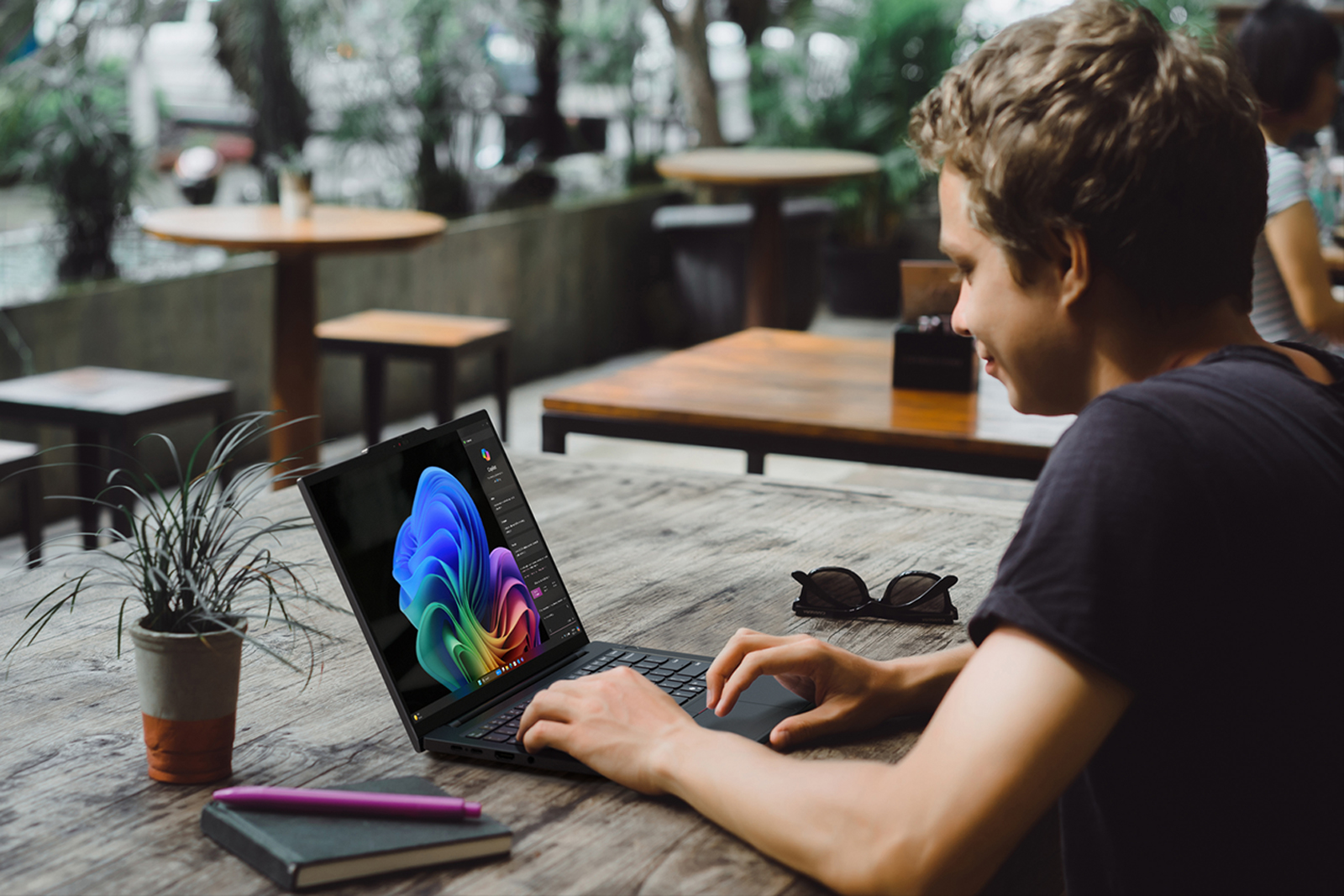
These devices are designed to drive a new era of Windows 11, the Copilot+ PC era. This is the AI umbrella that’s been popped over the top of everything. Copilot – Microsoft’s broad array of AI tools – was announced in 2023, but now becomes an integral part of the experience in a Copilot+ PC.
What will a Copilot+ PC offer?
In some ways, a number of things have aligned together. Microsoft is pushing its Copilot+ PC branding across a wider range of PCs, bumping Windows onto the AI bandwagon whether you like it or not.
Central to the discussion is now the NPU – neural processing unit – which is credited with running the AI side of things locally, with Microsoft going as far as saying that a Copilot+ PC needs to have an NPU that will run at 40 TOPS (trillion operations per second). The idea is that the AI functions run on the machine rather than in the cloud, making everything faster and better integrated, while addressing privacy concerns around sending all that data back and forth.
The functions outlined for Copilot+’s AI-enhancing functions include:
- Recall – allowing you to scroll back through time to find things you’ve lost track of on your PC, all organised by AI.
- Cocreator – generative AI-powered image creation that creates images as you sketch.
- Restyle Image – take an existing photo and change the style with AI support.
- NPU app support – Adobe, DaVinci Resolve Studio, CapCut, Cephable, LiquidText, djay Pro will all be able to use the NPU to power AI functions on-device.
- Live Captions – get live translation for any audio coming through your PC.
- Copilot key – so you can instantly access Copilot, your AI agent.
Who is coming to the Copilot+ PC party at launch?
One of the most powerful things about the announcement is that Microsoft isn’t standing alone – a lot of people have skin in the game. The following devices were also announced:
- Acer Swift 14 AI
- Asus Vivobook S 15
- Dell XPS 13, Inspiron and Latitude models
- HP OminBook X AI PC and HP EliteBook Ultra G1q AI PC
- Lenovo Yoga Slim 7x and ThinkPad T14s Gen 6
- Samsung Galaxy Book 4 Edge

IMAGE CREDIT: MICROSOFT
This all sounds exciting, but what does Qualcomm have to do with it?
Qualcomm has been providing the hardware for Surface devices for some time. The Surface Pro X and the Surface Pro 9 5G both ran on Microsoft-branded Qualcomm hardware. Qualcomm then announced Snapdragon X Elite in October 2023 at Snapdragon Summit, before announcing the slightly lower-tier hardware Snapdragon X Plus in April 2024.
Qualcomm, of course, has been in the ARM game for a long time, powering the majority of flagship phones for many years. Snapdragon X hardware is the exclusive platform powering Copilot+ at this stage, which is fortunate: with many smartphone brands talking about powering smartphones with alternative hardware – Samsung Exynos, Google Tensor, MediaTek Dimensity for example – Qualcomm gets to pivot into a powering PCs with Microsoft and all those other brands on board.
That brings me all the way back to the advantages that a full ecosystem charge behind Windows on ARM will bring. Snapdragon X appears to be a powerhouse, both in X Elite and X Plus forms. The message is that it leaves the Apple MacBook in its dust; Snapdragon X Series devices will be more powerful and more efficient.
That’s where the excitement comes in. Exactly how Copilot+ will enhance the experience remains to be seen – and it will be different for every user. But what speaks to me instantly is the promise of better battery life. Because if I can work longer, without a charge, it will make me more productive, wherever and however I choose to work.
And with this many players at the Copilot+ PC party, Windows on ARM has to work, app compatibility has to be a thing of the past – because we’re now all-in on the next-gen Windows experience.