There are two types of tablet owners. Those who want a laptop replacement with a big screen, a keyboard case and a spreadsheet open at all times. And those who want something to curl up with on the sofa for shopping or browsing, to read in bed, to doodle on and to throw in a bag for travelling or commuting. I sit in the second camp, which is why I’ve always had a soft spot for the iPad mini.
We haven’t had an upgrade for a couple of years, but the latest iPad mini gets an OLED display, a slimmer, lighter body, an IP67 rating, and the A20 Pro chip to match the iPhone Duo and iPhone 18 Pro. Apple calls it the biggest update the mini has ever had, and that’s true. But it’s also the biggest price hike it’s had. I’ve been using it for the past week to see if it’s worth it.
The Disconnekt Downlow
Pros
+ Punchy, vibrant OLED screen
+ Nippy performance
+ Brilliant size and weight
Cons
– Expensive
– No 120Hz refresh rate
– Best performance requires 512GB
The Apple iPad mini (A20 Pro) is a lovely tablet. It’s thinner and lighter than before, and the new 8.5-inch OLED display has plenty of punch. It’s nippy for everything you might want to do on a tablet, from work to gaming, and it remains the perfect size for reading, browsing, and note-taking. But this upgrade comes at a cost. The starting price has climbed by £200 compared with the iPad mini (A17 Pro), and at that price I’d have expected a 120Hz display and the full A20 Pro chip, regardless of the storage option. It’s the best iPad mini Apple has made, but it’s no longer the easy recommendation it once was.
The reasons you should choose the Apple iPad mini (A20 Pro)
When I reviewed the previous iPad mini in 2024, I said I’d have liked slimmer bezels and moaned about the front camera sitting on the portrait edge. They were first-world problems for sure, but I’m thrilled both have been addressed in this latest model. The bezels are noticeably thinner, which has increased the display from 8.3 inches to 8.5 inches without increasing the footprint, and the front camera has moved to the landscape edge for more natural video calls. It’s not actually in the centre, but I’m choosing to look past that odd design detail.
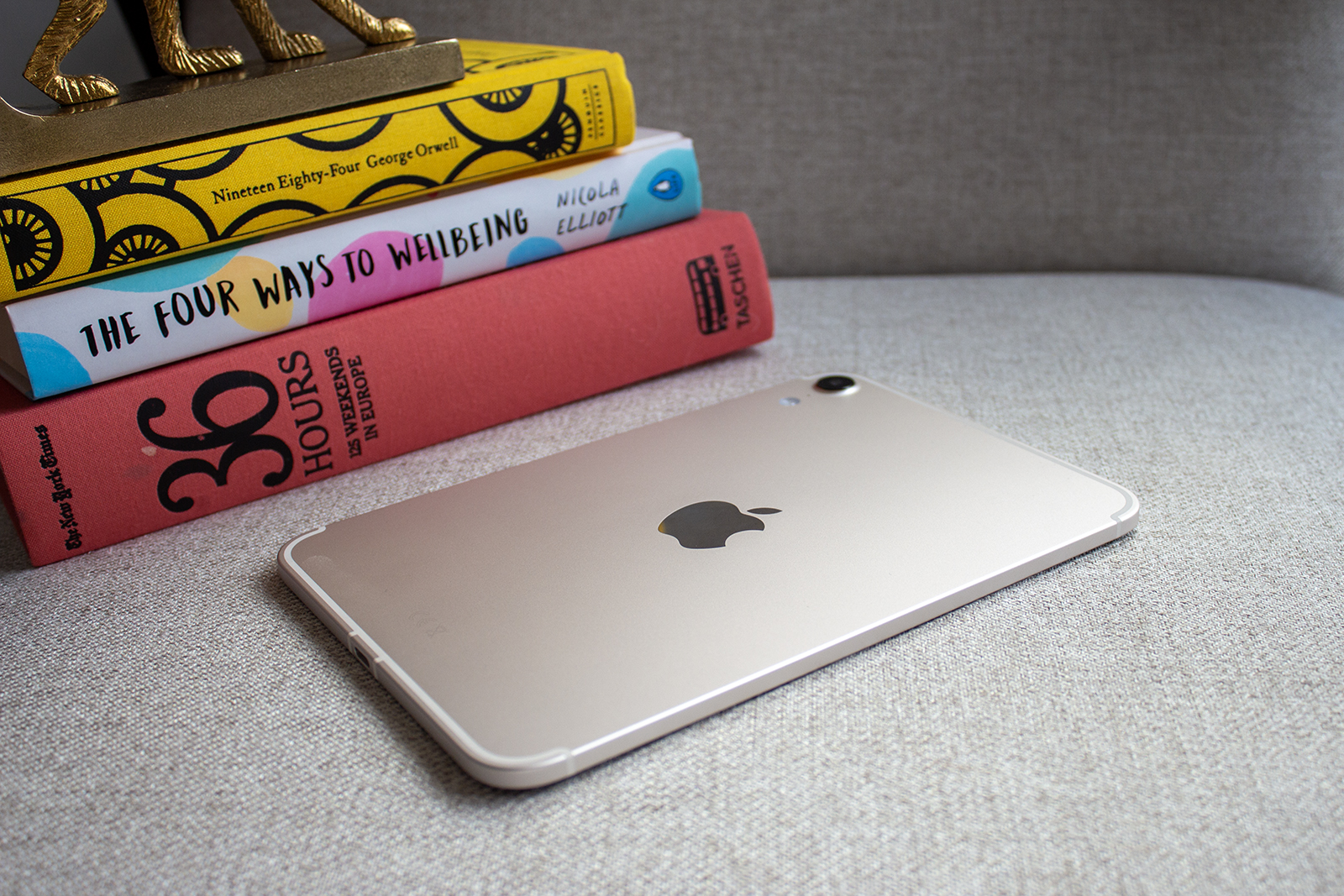
The aluminium body has slimmed down too. It’s now 5.4mm thick, down from 6.3mm, so while it’s not quite as slim as the iPad Pro (M5), it’s not far off – we’re talking a fraction of a millimetre here. The Wi-Fi model weighs 255g, down from 293g, and you really do feel the difference in use. It’s lovely and light and it’s even easier to hold in one hand for long reading sessions. If you’re choosing between this and the iPhone Duo – they are almost identical in weight with the Duo at 254g.


IMAGE CREDIT: THE DISCONNEKT
Colour options are limited to just Midnight or Starlight, and while I’d have liked a few extra colours like the regular iPad and iPad Air, both are tasteful. For the first time on an iPad, there’s an IP67 rating for water and dust resistance, too, so reading by the pool or in the bath is no longer something to panic about and Touch ID remains in the power button, which works quickly and reliably. I’d love to have seen Face ID like the iPad Pro, but I’m less irritated by Touch ID here than I am on the iPhone Duo.
It’s the display where this iPad shines, though. It offers plenty of punch with rich colours and inky blacks, while HDR content looks great, with its peak brightness of 1,200 nits, which is more than double the previous mini model. At the other end of the scale, the display drops to just 1 nit, so reading in bed in the dark doesn’t sear your eyeballs or keep your other half awake. There’s also a nano-texture glass option to cut glare if you work outside a lot, though only on the 256GB and 512GB models and for extra of course. My review model didn’t have it, but I have it on my MacBook Pro and iPad Pro, and it is a finish I would personally opt for, even if it can be guilty of washing things out a little.
“
Fast charging is almost reason enough on its own to upgrade an older iPad mini to this one.
Performance is nippy, as I expected given the iPad mini is powered by the same processor as the iPhone 18 Pro and iPhone Duo. The A20 Pro is built on a 2-nanometre process, and everything I did, from flicking between apps to editing photos and playing games, felt quick and fluid. Battery life is quoted at up to 10 hours, the same as before, but the mini now supports fast charging, reaching 50 per cent in 30 minutes with a 35W or higher adapter. You’ll need to buy that separately (pretty standard these days), but fast charging is almost reason enough to upgrade an older iPad mini to this one.
There are a couple of other upgrades worth mentioning, too. The speakers have been reworked into what Apple calls an Acoustic Display, with woofers that fire through the screen and tweeters tucked between the glass and the aluminium frame, so there are no speaker holes in sight. Movies sound surprisingly good, and while I’d always choose to use headphones to spare my fellow commuters, if you don’t have any, the speakers will more than suffice. Elsewhere, the rear camera gets an Adaptive True Tone flash, which helps when scanning documents (basically the only reason a camera on a tablet should ever be used), and Apple’s own N1 and C2 chips bring Wi-Fi 7, Bluetooth 6 and faster 5G on the cellular model.
What the Apple iPad mini (A20 Pro) could do better
The elephant in the room is the price. The iPad mini (A17 Pro) started at £499/$499. This one starts at £699/$699 for the 128GB Wi-Fi model and £849 for the cellular model. While all tech is facing price hikes, that’s a big increase for such a small tablet. Add the new £79/$79 Smart Folio and a £129/$129 Apple Pencil Pro, and you’re looking at north of £900/$900 before you’ve even thought about extra storage. I can see where some of the money has gone, but it does change who the mini is for.
That higher price makes the lack of a 120Hz refresh rate even harder to overlook, too. Last time round, I called the 60Hz screen a minor gripe on a £499 tablet. On a £699 tablet with an OLED panel, it’s a huge omission – especially when you can get Android tablets offering 120Hz OLED screens for half the price. Scrolling is perfectly smooth for most people, but if you’ve used an iPad Pro or a recent flagship phone, you’ll notice the difference.


IMAGE CREDIT: THE DISCONNEKT
It’s also worth noting that not every iPad mini gets the same chip. The 128GB and 256GB models have a 5-core CPU and a single 16-core Neural Engine, while the 512GB model has a 6-core CPU and a dual 16-core Neural Engine with 32 cores in total. Most won’t notice the difference day to day, but it’s worth remembering when choosing your storage that the top performance is reserved for the higher storage models. The same goes for the nano-texture glass, which isn’t offered on the 128GB model at all.
As with previous models, the smaller screen means the virtual keyboard takes up a fair chunk of the display, and multitasking with windowed apps is more cramped than on the larger iPads. It’s fine for a quick reply or two, but if working on the move is a priority, an iPad Air will suit you better.
Four fun facts about the Apple iPad mini (A20 Pro)
255
Grammes
The iPad mini (A20 Pro) is 5.4mm thick. The Wi-Fi model weighs 255g.
8.5
Inches
The iPad mini (A20 Pro) has an 8.5-inch OLED display with a 2,316 x 1,512 pixel resolution at 326ppi.
1200
Nits
The display reaches up to 1,200 nits peak brightness for HDR content and 600 nits full-screen.
512
Gigabytes
The iPad mini (A20 Pro) comes in 128GB, 256GB and 512GB storage options.
A bit about iPadOS 27, Apple Intelligence and Siri AI
The iPad mini (A20 Pro) runs iPadOS 27, like the rest of the iPad models. Liquid Glass has been tweaked so text is easier to read against busy backgrounds, and there’s now a slider in Settings to choose how glassy you want it, from completely clear to fully tinted. App names now appear in the status bar so you can see which window is active, the menu bar is quicker to bring up, and iPhone apps can finally be resized on the iPad. Extended display support is coming to the mini with iPadOS 27.2 as well, if you fancy plugging it into a monitor.
But the bigger story from a software perspective is Siri AI, a completely new version of Apple’s previously pretty useless assistant. It can now dig through your messages, emails and photos to find things, understand what’s on your screen and answer questions on pretty much anything. It also has its own app, where your conversations are saved and synced across any other Apple devices, and you can also swipe down from the top of the screen to ask Siri something via Spotlight. Meanwhile, Visual Intelligence lets you circle something on screen to search for it or act on it, like a date for your calendar. I’ve been hugely impressed with Siri AI over the last few months – it’s found everything from a marinade recipe my mum sent me in 2023 to an email about Christmas drinks I knew I’d seen but couldn’t find for the life of me.

IMAGE CREDIT: THE DISCONNEKT
There are some caveats, though. Siri AI is still in beta; it isn’t available in the EU on iPad for now; and some features that rely on Apple’s servers have daily usage limits. Apple has also said that expanded access to those features will come at a fee in the future, which is something to keep an eye on.
Elsewhere, Image Playground can now create photorealistic images (though I still don’t see the point of any of these tools), Photos gets a few extra features including Reframe, Extend, and an improved Clean Up, and Write with Siri works in your handwritten notes as well as typed text. For families, the redesigned Screen Time adds Ask to Browse, so children need approval before visiting new websites, and this works brilliantly. It makes the mini a more comfortable choice for sharing with younger members of the household – my 8-year-old adores it.


IMAGE CREDIT: THE DISCONNEKT
Should you buy the Apple iPad mini (A20 Pro)?
The iPad mini (A20 Pro) is the best iPad mini Apple has ever made by quite some distance. The OLED display has plenty of punch, performance is fast and consistent, and it’s thinner and lighter than ever, making it the perfect size for reading, browsing and taking notes. Apple has also fixed the two things I moaned about last time, with slimmer bezels and a landscape front camera, while throwing in water resistance for good measure.
But it’s incredibly expensive. A £200 jump in the starting price is significant, and it takes the mini out of impulse-buy territory. At £699, the lack of a 120Hz display is disappointing, and you have to opt for the 512GB model to get the full A20 Pro chip and make the most of Apple’s performance claims. If you love the iPad mini and can stretch to it, you won’t be disappointed; it’s a lovely device to use every day. But if budget is a big factor, the previous model is still a great tablet and should be available for less.

IMAGE CREDIT: THE DISCONNEKT
FAQs
The iPad mini (A20 Pro) features a larger 8.5-inch OLED display compared with the 8.3-inch LCD on the A17 Pro model, with more than double the peak brightness and an optional nano-texture finish. It’s thinner at 5.4mm compared with 6.3mm, lighter at 255g compared with 293g, and it adds an IP67 rating, a landscape front camera, an Acoustic Display speaker system, fast charging, Wi-Fi 7 and Apple’s C2 modem on cellular models. It runs on the more powerful A20 Pro chip and is available in Midnight and Starlight.
The Apple iPad mini (A20 Pro) starts at £699/$699 for the Wi-Fi model with 128GB of storage. The Wi-Fi and Cellular model starts at £849/$849. It’s available from 6 November.
The iPad Air (M4) is the more powerful and larger of the two, with 11-inch and 13-inch options and the M4 chip, making it better suited to working on the go. The iPad mini, however, has the more advanced display, with OLED compared to the Liquid Retina LCD on the Air, and it also has an IP67 rating, fast charging and an Adaptive True Tone flash. Both have Touch ID in the top button, a landscape 12-megapixel front camera, Wi-Fi 7 with Apple’s N1 chip, and support for Apple Intelligence, Siri AI and the Apple Pencil Pro.