I’ve had an Apple Watch on my wrist for over a decade. It’s survived weddings (including the morning of my own), dog walks, countless Peloton rides and swims. Over the years, it’s given me thousands of nights of sleep data, too, all of which I now have a Sleep Score for, thanks to that feature being added with watchOS 26 last year.
While the general shape of the Apple Watch hasn’t changed since the original model (all straps remain compatible) there have been incremental changes over its lifetime – the biggest of which occurred with the Series 10 in 2024, 10 years after the first model.
If you’re an Apple Watch fan, you should know not to expect fireworks every year. Instead, you usually get a couple of small upgrades that let the watch do its job a bit better than the previous model, and the Apple Watch Series 12 does exactly that. It retains the design introduced on the Series 10 as the Series 11 did, but this year, it also does something I’ve wanted it to do for years.
The Disconnekt Downlow
Pros
+ Readiness score, at last
+ Heart rate tracking feels sharper
+ Steps finally get a complication
Cons
– No changes to battery life
– No stress tracking
– Some features not available yet
The Apple Watch Series 12 isn’t a dramatic reinvention, but it finally adds two features I’ve spent years asking for, alongside a sharper heart rate sensor and a set of AI tricks that could be useful for many rather than gimmicky. There’s still no stress tracking, battery life remains at a day and night in normal use and some features aren’t here yet. But if you’re due an upgrade, and you’re coming from an older model than the Series 10, this is a great buy. Those with one of the more recent Apple Watch models may want to sit this one out, unless like me, you’ve been waiting for years for a readiness score.
The reasons you should choose the Apple Watch Series 12
Let’s start with the Series 12’s biggest change: health tracking. Now, I won’t lie: I thought this was already excellent on the Series 11. It remains excellent here, with workouts logged accurately, sleep tracking still great (even if very positive compared to other trackers), and all the fundamentals are still present, from sleep apnoea tracking to hypertension notifications.
That said, heart rate tracking feels a little more responsive on this smartwatch. Again, I never had a complaint about the Series 11 on this front; it did its job perfectly well in my experience, but Series 12 appears to be a little quicker to catch a spike when I pick up the pace. Apple has rebuilt the internals with what it’s calling the Health Sensing System, paired with a new S11 chip and larger optical sensors. The result is heart rate measured every 5 seconds around the clock, rather than every 5 minutes as before. Heart rate variability is checked more often too and is now included in the Vitals app, which also now offers a daytime view as well as a nighttime view so you can keep track of your data better.


IMAGE CREDIT: THE DISCONNEKT
I can’t independently verify Apple’s claim that this makes it the most accurate heart-rate sensor of any wearable, but it certainly doesn’t feel like a step backwards, nor does it seem to lag behind the chest strap I tested it against or the smart rings I was wearing alongside it.
What’s more exciting to me, however, is that the new system and processor have finally enabled Apple to offer a daily readiness score. This has been standard on rival wearables for years, and every September, when I review the new Apple Watch, I mention the lack of a readiness score as a ‘Con’. Well, this year, it’s moved into the ‘Pros’ column. The Series 12 analyses your recent training, vitals and sleep, then provides you with a single score out of 10, with a simple message below, such as Recover, Pace Yourself, Ready, or Go For It, to help you decide whether it’s a push day or a duvet day. The score shifts throughout the day as new data is logged, so a hard workout or a nap can knock it down or bring it up before bedtime.
“
I’ve seen the ceramic models in the flesh and they are lovely, as is the Dark Bronze aluminium model.
The second thing that’s been on my wishlist for years is that steps can now sit on your watch face as a standalone complication. Apple Watch has counted your steps since the very first model, yet you’ve always had to dig into the Fitness app to see the number. Now, on the new Siri Modular watch face, you’ll see them ticking up in the corner. It’s a small change, but I think it’s something people want, even if the whole 10,000-steps thing is a bit arbitrary and the complication doesn’t work on Snoopy.
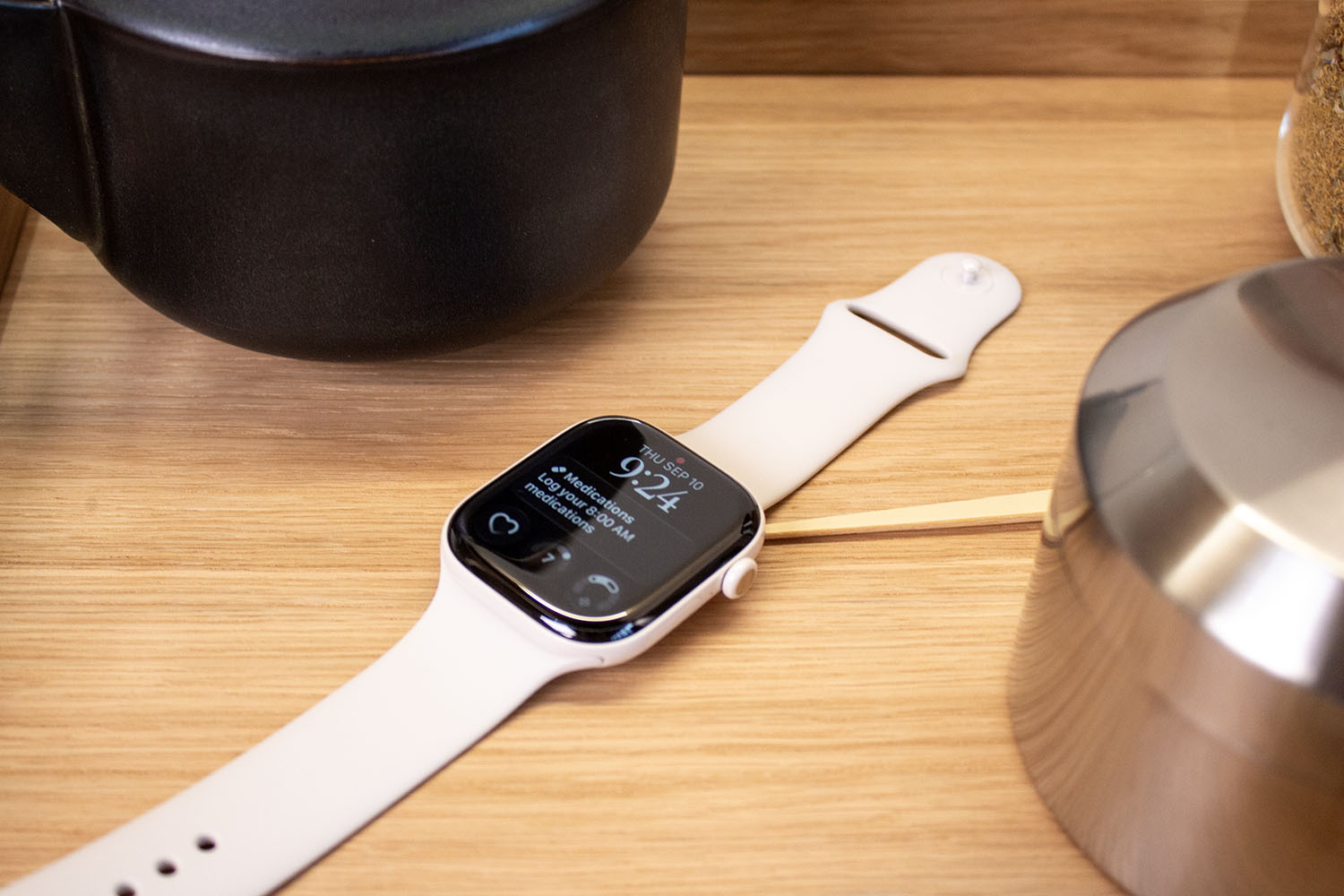
On the design side, aluminium models now use a tougher Ceramic Shield 2 cover glass, and there’s a fresh lineup of finishes including a Dark Bronze aluminium and a new Radiant Gold titanium, alongside a ceramic option in Pearl White (pictured) or Night Blue if you fancy something a bit different on your wrist. The Dark Bronze aluminium model comes with a matching Milanese Loop strap, which is great for smartening up the cheaper model, and I almost love it as much as my gold titanium Series 10.
What the Apple Watch Series 12 could do better
The biggest problem with the Apple Watch Series 12 is that the battery hasn’t improved. That’s not to say it’s bad, because I was ending my days at around 40 per cent, so I could easily get through a day and a night of sleep tracking before I’d need to top it up. But plenty of smartwatches far exceed 24 hours of use.
The fast charging means you get 80 per cent in 45 minutes or 8 hours in 15 minutes, but that requires you to be near that charging puck, and I would still like to see multi-day use from the Apple Watch at some point in the future.


IMAGE CREDIT: THE DISCONNEKT
The other current issue is that the new Audio Intelligence feature Apple has introduced are arriving in beta later this year rather than being available at launch. That means if you don’t buy the Apple Watch Series 12 now and hold out for Black Friday, you probably won’t miss out on them, at least not for long. As such, I haven’t tried them myself, but I did get a proper look at them in a briefing, so I can tell you a little about them.
Live Rewind lets you double-press the Digital Crown to pull up the last 15 seconds of a conversation as text if you missed something. It worked well, though I think Siri Recap, which produces a short summary of a conversation afterwards so you can jog your memory later, could be more useful in practice. I can see this being used at the doctor’s, for example, allowing you to get a summary of what was said without having to make notes.
Four facts about Apple Watch Series 12
2,000
Nits
The Apple Watch Series 12 has an Always On Display and a peak brightness of 2,000 nits, which is sufficient for outdoor viewing.
42/46
Millimetres
The Apple Watch Series 12 comes in 42mm and 46mm sizes, along with three finishes of aluminium, titanium and ceramic.
S11
Chip
The Apple Watch Series 12 has a new S11 processor, as well as a new Heath Sensing System and pedometer.
24
Hours
The Apple Watch Series 12 offers a battery life up to 24 hours in normal mode, or 38 hours in Low Power Mode.
Meanwhile, Sound Recognition alerts you to things like a doorbell, an alarm, or a crying baby, even when your iPhone isn’t nearby, which could be useful for anyone who is hard of hearing. The Series 12 will also automatically recognise songs without you having to open the Shazam app. I’ll reserve full judgement on these until I’ve lived with them properly, but they didn’t feel like AI window dressing.
The last thing I’d like to have seen in Series 12 is stress tracking. Other wearables like Garmin and Oura do a great job of this, so I’d love to have seen Apple use all the data it collects to help highlight when you might need to chill out a little. But alas, we can’t have it all.
A little about watchOS 27
Beyond the headline feature additions, there’s a good selection of extras in watchOS 27, though it is worth noting that many of these are available on older Apple Watch models, including the Watch Series 9, Watch Series 10, and Watch Series 11, as well as some of the Watch SE and Watch Ultra models. That’s more than can be said for the readiness score and step complication, both of which require Watch Series 12 hardware.
Still, back to the software. First up are enhancements to Workout Buddy, the AI-generated voice that cheers you on at milestones during a session. It no longer needs your iPhone nearby, so it’ll happily keep talking to you on a run even if you’ve left your phone at home. Apple’s also fed it more fitness data to draw on when it’s dishing out motivation, and it can speak Spanish as well as English, so “bien hecho”.

IMAGE CREDIT: THE DISCONNEKT
The watch face has also been redesigned, with a new dynamic app grid that surfaces five Siri-suggested apps based on what you use and when, rather than making you search through a static grid. It has definitely saved me a few taps so far, serving me up the Workout app at 6pm every night when I do my dog walk.
The Smart Stack that appears at the bottom of the main screen serves up smarter suggestions too, popping up with things like a parked-car reminder from Maps or a birthday nudge for a close contact when relevant. There’s also a new single-handed tap gesture that requires a quick pinch of your finger and thumb to select a widget in the Smart Stack, which pairs nicely with the existing double-tap for scrolling through them. It means you can operate the whole thing one-handed, which is particularly helpful when you’re holding a dog lead. I should know.
Elsewhere, Cycle Tracking now supports perimenopause and menopause, flagging deviations in your cycle for anyone over 40, which is a welcome and overdue addition and something a number of fitness trackers are starting to focus on. Oura is leading the charge here, announcing Menopause Insights alongside its Ring 5, so I’m thrilled to see Apple making moves here too.


IMAGE CREDIT: THE DISCONNEKT
Should you buy the Apple Watch Series 12?
If you’re coming from anything older than last year’s Apple Watch model, or you’ve never owned an Apple Watch, the Series 12 is an easy recommendation. It offers improved heart-rate tracking, a readiness score, a long-overdue steps complication, and a handful of promising AI features still to come, all wrapped in Apple’s usual polish that offers a great design and overall experience.
If you already own a Series 11, the decision is much harder, because on paper you’re paying for two new features rather than a reinvention of the Apple Watch wheel. But those two features happen to be the things I’ve spent the last few Septembers complaining were missing, so this is the first Apple Watch upgrade in a while that feels like a little more than just a spec bump. The Apple Watch Series 12 is a great smartwatch, but whether you should rush out to buy it will depend on who you are and what you currently have on your wrist.

IMAGE CREDIT: THE DISCONNEKT
FAQs
The Apple Watch Series 12 starts at £369/$369 for the 42mm aluminium, GPS-only model.
No. Readiness relies on the new Health Sensing System hardware inside the Series 12, so it won’t be coming to older models via a watchOS update.
Both are arriving in beta later this year, alongside Sound Recognition and an upgraded Shazam, as part of Apple’s new Audio Intelligence features.
No, the Apple Watch Series 12 only works with an iPhone.