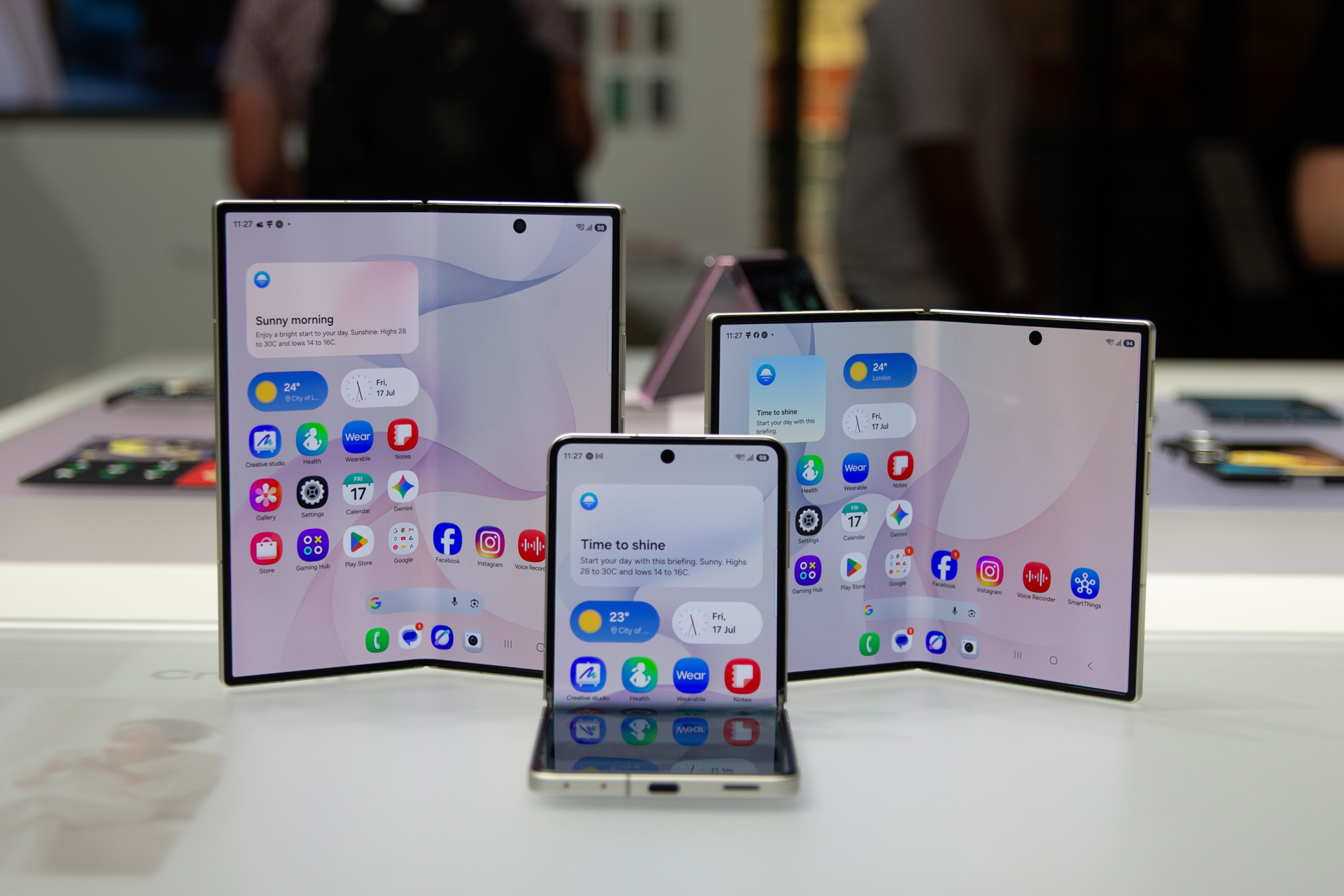
Samsung first tried a big folding phone, but it was too narrow and too expensive. Next Samsung tried a small folding phone, but it was too delicate and overpriced. Then Samsung tried a medium-sized folding phone and it was neither too big nor too delicate, it was just right, and customers gobbled them all up.
That’s the feeling you get from the latest Samsung line up, with the company that put folding phones on the map launching a trio of foldables for 2026. Having iterated on little and large for 7 years, it flirted with the Galaxy Z TriFold (a phone that basically folded before it got started) and now it’s settled on something smaller.
There’s a passport-like aesthetic to the new Galaxy Z Fold 8, the device that sees Samsung pivoting in a new direction. Cheaper than the Ultra, it sacrifices the cameras of the bigger folding phone, while giving you a 4:3-inch internal display.
That, as it happens, is what we’re expecting Apple to launch later in 2026 in the iPhone Ultra, with Samsung setting out its stall with a couple of months to spare.
What really works in the Galaxy Z Fold 8
The Galaxy Z Fold 8 is clearly a product of everything that’s come before it. It benefits from the slimming down of previous Galaxy Z models, so it’s still pocketable, while the 5.5-inch external display is big enough to be useful. Open it up and the 7.6-inch screen is like a mini tablet.


IMAGE CREDIT: THE DISCONNEKT
My biggest problem with folding phones has always been purpose. For all the work that Samsung put into expanding the external display, I’ve always struggled with the larger internal screen. Originally it was wonderful for scrolling through square images on Instagram, but as everything has moved towards vertical presentation, even social media didn’t really fit.
Square folding phones are bad for content, because it’s a shape that no one uses, giving you neither height nor width. Don’t even get me started watching movies, where the letterboxed display is worse than a normal phone.


IMAGE CREDIT: THE DISCONNEKT
That changes on a 4:3 display. Rotate it into portrait and the web looks wonderful, reducing the scrolling and allowing you to enjoy website design (if there is any). In landscape it’s a better entertainment space, fitting video content better. It’s also the aspect used for the iPad and Apple didn’t choose it by accident.
The Galaxy Z Fold 8 could be the Goldilocks device that’s “just right”, but that does raise a question about the other two phones.
Samsung doubles-down on the Ultra message
Samsung started talking about “ultra” before the launch of the Galaxy Z Flip 7. Many were convinced it was going to launch an Ultra version, but that never happened. Instead, it was seeding the idea of this being an ultra phone, without going the whole hog and making it great like the Galaxy S26 Ultra.


IMAGE CREDIT: THE DISCONNEKT
There’s a slightly bigger battery with faster charging, a tweaked ultrawide camera and the display is a little brighter, but it’s very much an update of the phone that came before. Carrying the Ultra name – only shared by the Watch Ultra and the aforementioned Galaxy S26 Ultra – it doesn’t really feel like it should have that badge.
Sure, it has the best camera of the Galaxy Z family and the biggest battery, but it’s no more powerful than the Galaxy Z Fold 8. Both run on the Snapdragon 8 Elite Gen 5 for Galaxy. Perhaps the Ultra refers to the price, which at £1899 is definitely up there.
But we still love the Flip, right?
Okay I admit it, I do love the Flip. The Galaxy Z Flip 8 is basically the same as the Galaxy Z Flip 7, with minor changes including faster charging. That will be welcomed, because the 4300mAh battery isn’t known for its longevity.
It’s now thinner and lighter, but having played with both, you really can’t tell that it’s any different. It does come in a fabulous Pink colour and I can’t help but think that some people are going to go wild for it.


IMAGE CREDIT: THE DISCONNEKT
The Flip is distinctly different to the Fold models. It has that retro appeal of clamshell phones of the past, while offering a practical solution: it fits into a bag and pocket easily, while still packing in a 6.9-inch screen. I’ve used flip phones a lot and most of the experience is like using a normal phone when it’s open.
The cover screen, then, is an area where Samsung previously fell short. Motorola offered full apps on the cover screen so it was much more useful. Now Samsung does the same so you’re not just limited to music controls, notifications and widgets. Now you can navigate, call an Uber, watch YouTube or whatever else you might want to do.
But with all that said, as long as the Galaxy Z Flip 7 gets an update to bring those clever screen features to the older device, you’ll get much the same experience for less money.
And that might be the decision that many make: rather than spending £1149 on the new Flip, you could be spending as little as £899 when the Z Flip 7 hits the sales again.

IMAGE CREDIT: THE DISCONNEKT
It’s a full selection, but there’s only one hero
Samsung has experimented with folding phones over the years and the Galaxy Z Fold 8 might just be another experiment to make this more expensive format work. But unlike the Z Fold 8 Ultra, I can see real purpose behind the Z Fold 8. It’s a phone I’m excited to try, feeling slightly less compromised, with a display that’s going to give you more.
For the Z Fold 8 Ultra and the Z Flip 8, the increased prices are likely to push people to the older models, safe in the knowledge that it’s pretty much the same as it was the year before.